Si DRIE System RIE-800iPBC
Flexible Bosch and Non-Bosch Processing with Cassette-to-Cassette Automated Wafer Handling
Description
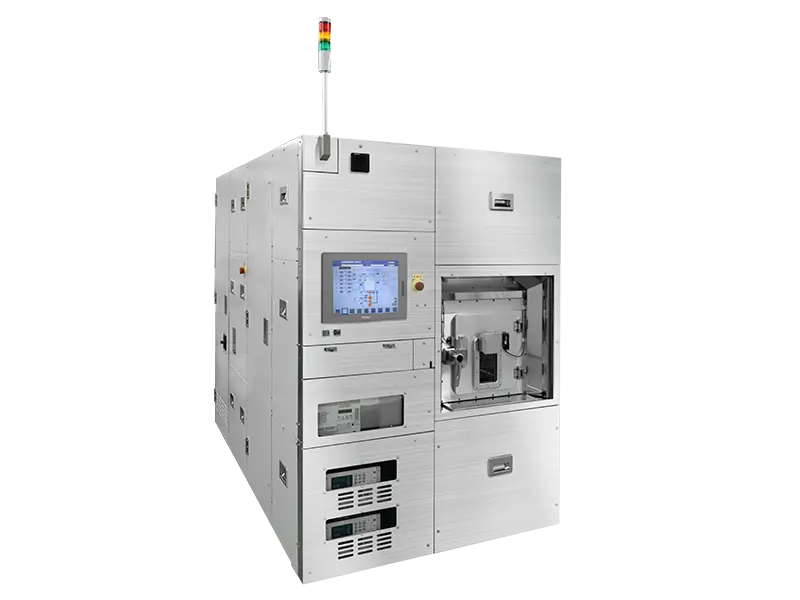
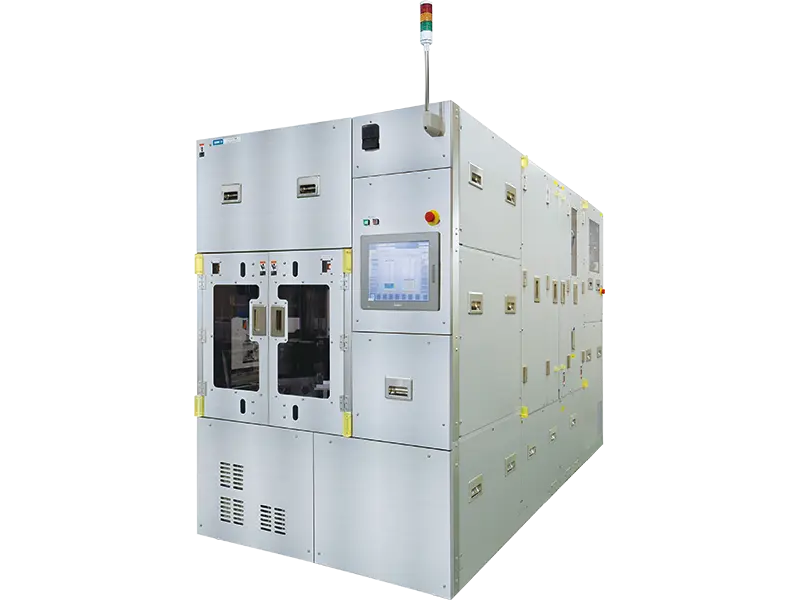
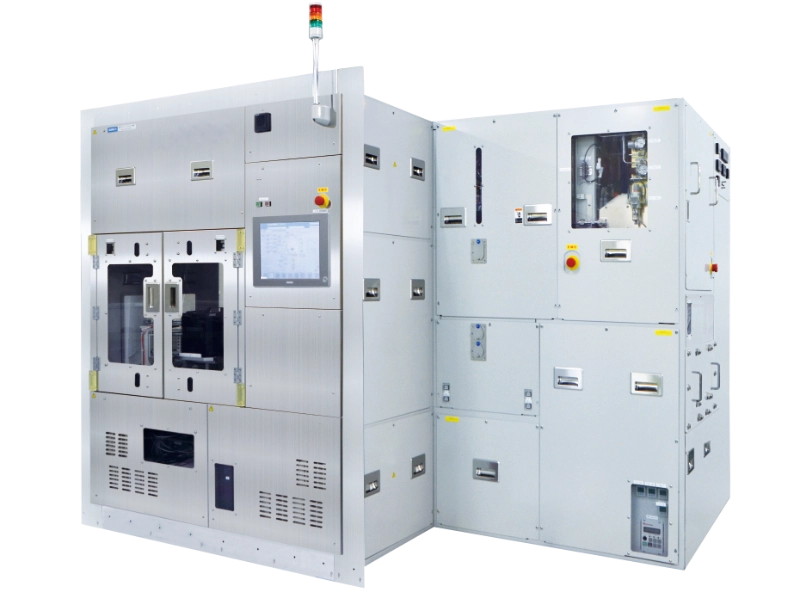
The RIE-800iPBC is a high-performance Silicon Deep Reactive Ion Etching (Si DRIE) system engineered for high-volume manufacturing (HVM) in MEMS, TSV, and advanced packaging applications.
Building upon the proven etch performance of the RIE-800iPB, the RIE-800iPBC integrates an automated Cassette-to-Cassette transfer system, enabling continuous single-wafer processing for substrates up to ø8 inches without compromising vacuum integrity or introducing ambient contamination.
Key Features and Benefits
- Dedicated Bosch process ICP coil enables efficient application of up to 5,000 W RF power
- High-speed gas switching (0.1 s) achieves low-scallop sidewall processing
- High silicon-to-photoresist selectivity of over 500:1
- High silicon etch rates exceeding 45 μm/min
- Capable of high-aspect-ratio etching exceeding 100:1
- Suppresses tilt to ensure high process uniformity across ø8-inch wafers
- Supports parameter ramping for optimized process control
- Enables non-Bosch processing for scallop-free etching and tapered sidewall control
- Extensive process library available
Applications
- MEMS device fabrication (accelerometers, gyroscopes, pressure sensors, actuators, etc.)
- Deep silicon etching for TSVs and 3D integration
- Microfluidic device fabrication (microchannels, μTAS, etc.)
- Quartz (SiO2) microfabrication for optical components and fluidic substrates
- R&D applications in photonics and advanced microstructures
Papers & Publications
- Watanabe, Naoya, et al. "Development of a high-yield via-last through silicon via process using notchless silicon etching and wet cleaning of the first metal layer." Japanese Journal of Applied Physics 56.7S2 (2017): 07KE02.
- Takase, Shun, et al. "Thick film MEMS process using reverse lift-off." Microelectronic Engineering 281 (2023): 112081.
- Tsuchiya, Toshiyuki, et al. "Tensile fracture of integrated single-crystal silicon nanowire using MEMS electrostatic testing device." Procedia Structural Integrity 2 (2016): 1405-1412.
Related Products
Explore more products in Si DRIE Systems



