Samco
ALE Systems
As next-generation compound semiconductor devices such as GaN HEMTs, SiC power transistors, and high-density 2D electronics continue to scale down, conventional continuous Inductively Coupled Plasma (ICP) etching encounters critical physical limitations. Standard plasma processes often introduce crystal lattice degradation, surface roughness, and uncontrolled over-etching due to high-energy ion bombardment and continuous chemical exposure. Samco’s Atomic Layer Etching (ALE) technology overcomes these physical constraints by decoupling the etching process into sequential, self-limiting reaction steps. By strictly separating chemical surface modification from reaction product desorption, our systems deliver sub-nanometer depth precision, preserve underlying crystal integrity, and ensure complete immunity to micro-loading across varying pattern densities, bridging the gap from advanced laboratory research to high-volume manufacturing.
-
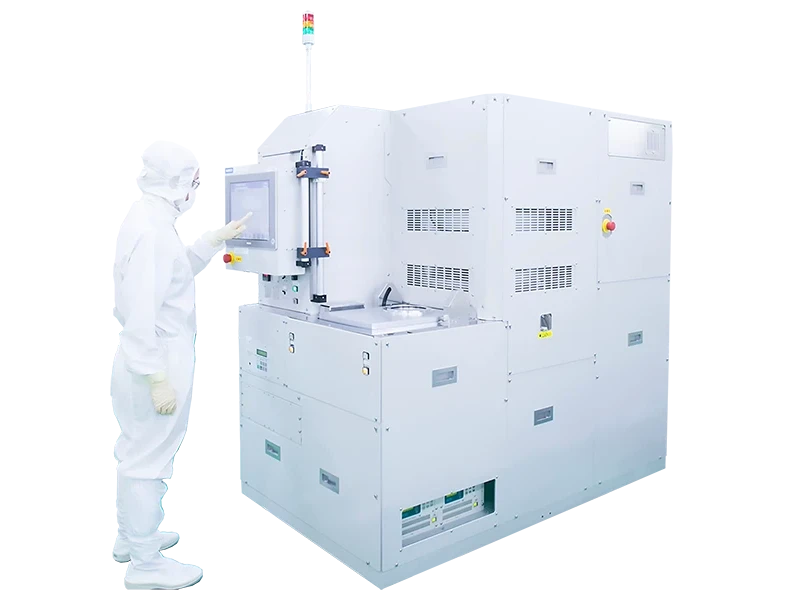
ALE System RIE-400iP-ALE
Atomic-Scale Etch Precision



Features of ALE Systems
Executing reproducible atomic-scale material removal requires strict engineering control over gas dynamics, plasma density, and substrate bias power. Samco integrates precise hardware subsystems within a unified processing chamber to maximize process control and minimize overall cycle durations.
To achieve precise execution during cyclic operations, Samco incorporates a Fast-Switching Gas Input Valve Unit. Rapid reactant dosing and high-speed chamber evacuation cycles ensure extremely sharp process transitions while drastically reducing dead times between exposure phases. Plasma generation is driven by the proprietary HSTC™ (Hyper Symmetrical Tornado Coil) ICP Source, which sustains a high-density, highly uniform plasma across the entire substrate even under low-pressure conditions. This source maintains stable discharge operation at RF power levels exceeding 2 kW, ensuring abundant radical generation while constraining energetic ion species.
To prevent lattice degradation during the desorption step, Samco utilizes an Attenuated Low-Bias Power Control architecture. By integrating a dedicated RF matching network with an attenuator circuit, the system delivers stable low-bias power to the substrate, eliminating unwanted high-energy ion bombardment. Process termination and layer monitoring are further optimized through Integrated In-Situ Endpoint Detection, combining laser interferometry and Optical Emission Spectroscopy (OES) to track monolayer removal in real time for automated, highly repeatable process control.
Samco ALE platforms target critical manufacturing bottlenecks where atomic-scale surface control directly dictates device performance and breakdown characteristics.
In GaN HEMT Gate Recess and p-GaN Selective Etching, the system achieves controlled, repeatable monolayer removal per cycle. The process delivers exceptionally high chemical selectivity over underlying stopping layers, maintaining minimal interface state density and low sheet resistance required for normally-off E-mode power devices. Furthermore, in Micro-Loading Free Silicon and Oxide Patterning, the self-limiting chemical mechanism completely eliminates aspect-ratio-dependent etching across wide-ranging aperture sizes, yielding identical etch depths regardless of feature dimensions or local pattern density.
ALE Systems FAQ
- Can Samco’s Atomic Layer Etching (ALE) systems also operate as standard Inductively Coupled Plasma (ICP) etching systems?
- Yes. Samco ALE platforms feature a fully integrated dual-mode architecture that allows seamless switching between conventional continuous ICP etching and cyclic ALE processing within the same chamber. This dual functionality enables high-rate bulk material removal using standard ICP mode, followed by transition to ALE mode for precise, atomic-scale recessing and layer control without breaking vacuum.
- What are the primary process advantages of having both ICP and ALE capabilities in a single system?
- Combining continuous ICP and cyclic ALE modes optimizes total process time and capital efficiency. Continuous ICP etching rapidly clears bulk material down to a target interface, after which the system switches to ALE mode to achieve self-limiting, monolayer-level precision with minimal crystal lattice damage. This hybrid approach eliminates the need for separate dedicated processing tools, reducing system footprint and wafer handling overhead.
- What is the fundamental difference between conventional reactive ion etching (RIE) and Atomic Layer Etching (ALE)?
- Conventional RIE relies on continuous plasma exposure combining chemical reaction and physical sputtering simultaneously, which can cause substrate damage and non-uniformity at sub-nanometer nodes. ALE operates via a cyclic, self-limiting process consisting of two separate steps: chemical modification of the top atomic layer (e.g., surface adsorption) followed by selective removal of that modified layer using low-energy ions. This self-limiting reaction provides atomic-layer thickness control, high selectivity, and minimal sub-surface damage.
- Can Samco ALE processes scale from R&D (Lab) to volume production (Fab)?
- Yes. Samco designs ALE chamber configurations to share core process architectures across both single-wafer R&D units and cluster-tool production platforms. The digital nature of ALE—where etch depth is governed by cycle count rather than strict time/temperature control—ensures high process transferability, low wafer-to-wafer variation, and reliable scalability from initial feasibility studies to high-volume manufacturing.
- How does ALE contribute to improving device reliability in power and RF electronics?
- In high-power and high-frequency devices (e.g., GaN HEMTs, SiC MOSFETs), conventional plasma etching introduces lattice defects and dangling bonds, leading to current collapse and threshold voltage shifts. By utilizing low-energy removal species below the physical displacement threshold of the substrate, ALE leaves an atomically smooth, damage-minimized surface. This improves channel mobility, reduces gate leakage current, and enhances long-term operational reliability.

